Summary
Package a scheme’s technology as four scopes and you buy a specialist management-and-margin layer four times. One trusted partner across a technology scope prices it once. You’ll see the difference in your numbers.
You price setting up a site once, however many packages sit underneath it (you don’t hire the crane four times for the same site). What multiplies is the job management every specialist builds into their own rates, and you end up paying for it over and over again.
One partner across four solutions helps reduce your margin leak, and because the detail is all in preliminaries, your QS can confirm it line by line.

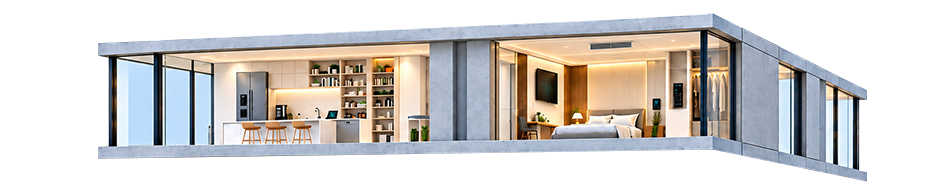
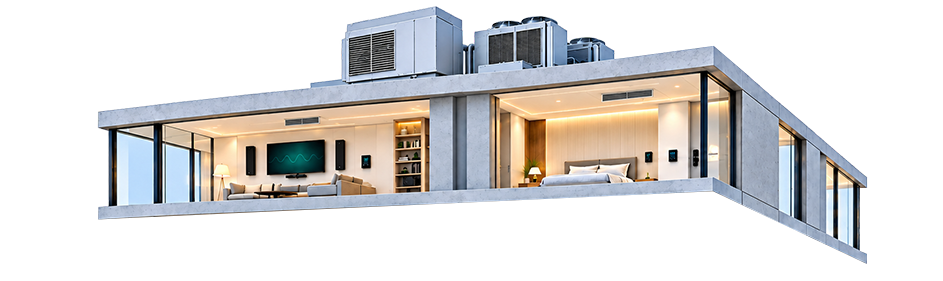
Let’s think about the moment you package a scheme’s technology. You’ve got HVAC, AV, digital appliances and connected guest technology, and the straightforward move is to send them out as four scopes to four specialists. Each one prices up, each looks competitive, and nobody raises a problem. The trouble is that every one of those four specialists builds in a cost of managing itself, so by buying four packages you’ve bought that management layer four times over. One trusted partner across an entire scope prices it once.
Why it’s your margin, not your client’s cost
As the main contractor you pay for duplication. Once in the number, where you’ve got four suppliers quoting for jobs instead of one. And again across your site team’s week, because four subcontractors have to be coordinated into the same building against four separate programmes. When one of the four slips, its time-related costs keep accruing, on your programme, against your margin. Costs start to increase where your delivery risk is, as the main contractor who has to open the building on time and on budget.
Green lights from your QS
Your QS will probably be one of the first to ask questions, so let’s be precise about where we see the duplication occurring. Preliminaries split into two levels. Your main-contract preliminaries, including site establishment and the management of the whole job, you price once however many packages there are. NRM2 is clear on that, and it’s logical, because your crane isn’t hired four times for the same site. Work-section preliminaries are when things start to add up. Every subcontract package prices its own supervision and its own package management, and this is exactly the cost that multiplies. Four packages means four of those costs, four margins, and then you add your price, preliminaries and margin over the top of the lot.
We’re not suggesting that your main-contract prelims duplicate, that’s factually incorrect, but what we are saying is the preliminaries surrounding four suppliers (which could be one) keep adding up with every new subcontract added to the scheme.
Where is the risk lands, and whether the building opens
If you want to see the shape of this before your QS prices it against your own scheme, here’s a worked example. Treat the figures as an illustration, because yours will come out differently, but it’s the mechanism we’re after here, not the exact numbers.
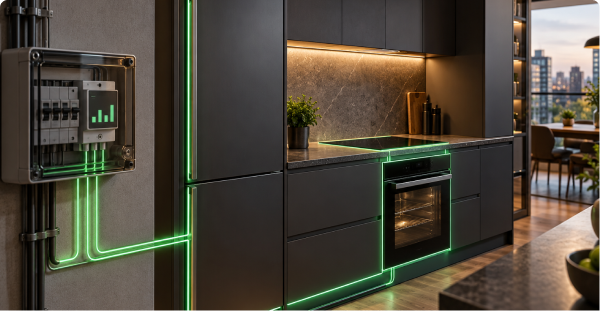
Say you’ve gone out to four packages. Site supervision is roughly £1,500 a week per package for as long as that package is on site, and package management adds another 40% of a £2,000-a-week manager on top of each one. Then you’ve got the fixed items, the mobilisation, the submissions, the commercial set-up and the handover documentation, and those come to about £8,000 per package. Site time varies by trade, so you’re looking at HVAC for 40 weeks, AV for 20, Digital Appliances for 8, and Connected Guest Technology for 24.
Now put that same scope under one partner. The supervision is assumed to be identical, because the engineers on site still need supervising and we’re not going to pretend that line away. Package management comes down to 60% of one manager across a 44-week combined programme, which is the overall run from the first package arriving on site to the last one being commissioned, rather than the four durations added together. And the fixed items come to £14,000, because each solution still needs its own documentation.
| Cost line (£) | Four packages | One package |
|---|---|---|
| Site supervision | 138,000 | 138,000 |
| Package management | 73,600 | 52,800 |
| Fixed package items | 32,000 | 14,000 |
| Total package prelims | 243,600 | 204,800 |
That’s a £38,800 saving, about 16% of the package prelims, and you get it without changing how a single engineer is supervised. On its own it looks like a modest line. The real prize is in the programme, which is the next part.
Green lights from your QS
Those work-section preliminaries split into fixed and time-related, exactly the way your own main-contract prelims do. The time-related part, the supervision and the package management, keeps accruing for as long as that package is on site. So four packages gives you four programmes, and every one of them has its own clock ticking away against your margin.
Here’s where it bites you. Connected Guest Technology can’t commission its in-room controls until your HVAC team have installed and tested theirs. So say HVAC runs three weeks late installing those controls for some reason nobody saw coming. Your guest technology package is left waiting, with its supervisor and its package manager both still on the clock. Against the figures above that’s around £6,900, and it’ll very likely come back to you as a prolongation claim. One sub points at the other, you’re left managing it, and it’s your programme and your margin taking the hit either way.
Put your whole technology scope into one contract and one trusted partner is responsible for all of that coordination. If there is a delay, it still costs you money, and we’re not going to tell you that vanishes, but we take responsibility for things like this, and adjust and manage it inside our own package, so there’s no claim flying between two of your subcontractors for your team to deal with.
While we’re confident in our ability, we’re not magicians. A delay upstream still impacts whoever’s waiting. If your electrical package is late, or access slips, it costs the same whether you’ve got one supplier or four. Where consolidation helps you is in closing the gaps between technology trades themselves, and that help grows the more specialist those trades are.
What one partner changes
So what changes when one accountable partner takes on all four solutions? You buy that specialist management once instead of four times, and the excess coordination that was eating your site team’s week comes off your critical path and is dropped inside one supplier’s contract. We can help you retain margin here, simply by removing duplicated processes and trimming down supplier volume. It’s a win-win, as you retain line item control over costed items, and still have input into what hardware makes the budget.
The decision
How many technology packages you tender is a margin decision. Four packages buy you four management processes, and gift the coordination to your own team. One trusted partner takes that coordination off your critical path. It’s all in the preliminaries, so your QS can price the difference on your own scheme.
We go into the wider picture, from design through to handover in ‘Where a four-package technology tender wastes money More of this series to follow.
Sources: RICS New Rules of Measurement 2 (NRM2), on main-contract and work-section preliminaries. RICS NRM1, on subcontractors’ preliminaries being priced into unit rates. CIOB Code of Estimating Practice, on what preliminaries cover. The worked example uses illustrative figures and should be priced against a real scheme.
Recent Article

Where a four-package technology tender wastes money
A four-package route looks like the safe, competitive choice. The cost shows up later, in variations, claims and four programmes that all depend on each other.
Read ArticleMargin leak inside four technology packages
Package a scheme’s technology as four scopes and you pay for the same management layer four times. One trusted partner across the scope prices it once.
Read ArticleReady to stop managing four suppliers and switch to one?
Fill out the form and we will be in touch within 20 minutes.